
FTC mandates consumer info tags on new TVs.
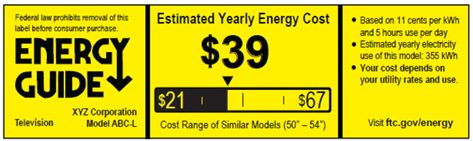 We’ve all seen “Energy Guide” labels on refrigerators, washers, and dryers, telling us how much energy they use. Get set: the big, yellow, sticky label is coming to your next TV. And, thanks to the Federal Trade Commission (FTC), it will be big, and yellow . . . and sticky (see below).
TV sets are often turned on many hours each day – for labeling purposes, the FTC assumes about five hours, although some commenters suggested that eight was closer to the truth – and not all consume the same amount of energy. To promote energy conservation, the Federal Trade Commission has adopted new rules requiring that all TV sets manufactured on or after May 10, 2011 be labeled to show their estimated annual energy cost and where they stand in comparison to other sets of similar size. In so doing, the FTC is flexing regulatory muscles that Congress gave it in the Energy Independence and Security Act of 2007 (which, as we all know, amended the Energy Policy and Conservation Act).
The text of the FTC’s Order has not yet been published in the Federal Register, although it is available in pre-publication form on the FTC’s website. Micromanagement Alert: The rules are extraordinarily detailed regarding the size, font, color, and content of the label, as well as how good the stick-um has to be to hold the label on the TV screen. For example, the official specs on the design shown above, in yellow, are as follows:

Minimum label size: 1.5” x 5.23”. And all the minutiae detailed above apply just to the front. For the back, adhesive labels must have “an adhesion capacity sufficient to prevent . . . dislodgment during normal handling”. A “minimum peel adhesion capacity for the adhesive of 12 ounces per square inch is suggested.” Alternative means of affixing the label (e.g., “cling labels” using the screen’s static charge) are also permitted.
Variations on the horizontal example shown above include a vertical design and a triangular design.
Surprisingly, the rule as initially proposed applied to any device with a built-in viewing screen, regardless of screen size. Didn’t they realize that pasting a big label on a Dick Tracy wristwatch TV screen wouldn’t be easy? The FTC appears to have gotten the word, though. The final version of the rule exempts TVs that “are designed to operate on built-in rechargeable batteries or inserted batteries.”
The FTC is also looking at requiring similar labeling for devices without screens, such as cable boxes and DVRs – but that’s for another day.
No word yet on when the new rules will appear in the Federal Register but, as noted above, they are currently set to apply to all non-exempt TVs manufacturer on or after May 10, 2011. Energy Guide labels will also have to be included in catalogs and website listings as of July 11, 2011.
And finally, the careful and law-abiding observer will note that the labels must include the warning that “Federal law prohibits removal of this label” – just like a mattress or pillow label! Oh sure, the TV version limits that prohibition to “before consumer purchase”, suggesting that it’s OK to remove the label once you’ve got the TV all set up at home. But do you really want to take that chance?
